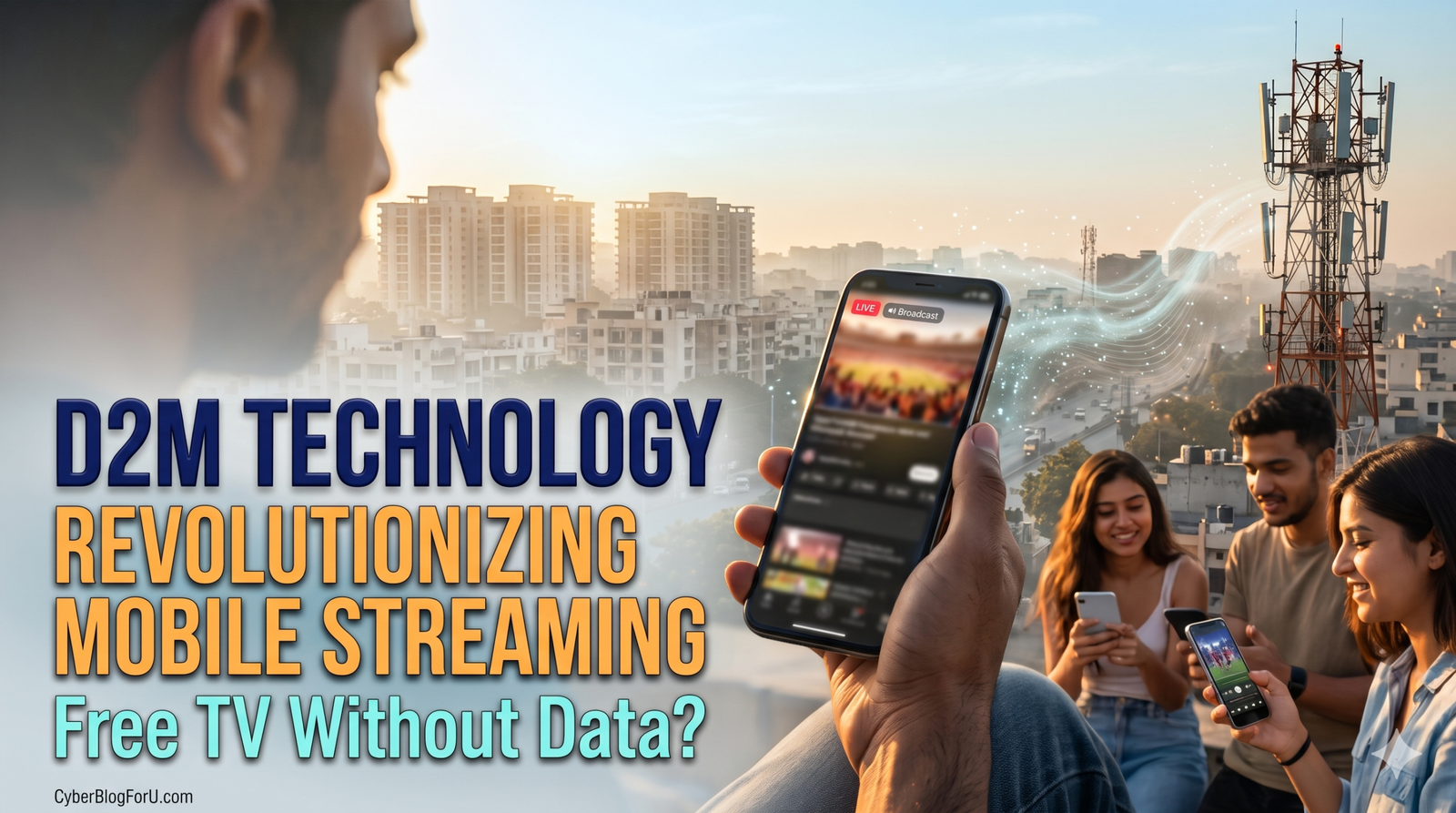
What Is D2M Technology? Discover How It Could Revolutionize Mobile Streaming

Quick Answer: What Is D2M Technology?
Direct-to-Mobile (D2M) technology uses terrestrial broadcast signals to deliver video, audio and data to compatible mobile devices without requiring a separate mobile-data or Wi-Fi stream for the broadcast content. It could support live television, education and emergency information, but a receiver and a broadcast service with coverage are required. For a broader look at the chips behind modern connected devices, see our guide to semiconductor technology.
India rollout update (6 November 2026): D2M is not yet a nationwide consumer service. Reporting on 6 October said device support would remain voluntary and that Prasar Bharati was preparing an RFP for commercial deployment. An expected tender date is not the same as a confirmed launch. Do not assume that an existing 4G or 5G phone can receive D2M.
Table of Contents
What Is D2M Technology and Why Is India Exploring It?
Imagine watching a live cricket match on your phone without consuming your daily mobile data allowance. That is one of the possibilities behind D2M technology. D2M combines digital broadcasting with mobile-device reception. India’s public broadcaster, Prasar Bharati, and technology companies have been exploring ways to deliver multimedia content directly to compatible devices.
The potential goes beyond entertainment. D2M could support educational content in areas with limited connectivity and help distribute public information during emergencies.
In an official statement published on 1 April 2026, India’s Ministry of Information and Broadcasting described D2M as a way to broadcast video, audio and data to mobile handsets independently of SIM cards or mobile data.
How Does D2M Technology Work?
To understand the difference, consider how you watch a popular live event today. With conventional mobile streaming, each viewer receives an individual stream over a cellular network. If thousands of people watch the same event in one area, their combined traffic can put pressure on network capacity.
D2M introduces another delivery method: broadcasting common content to many receivers at once.
Here is the simplified process:
- Content preparation: A broadcaster prepares live TV, video, audio or other data for transmission.
- Broadcast transmission: D2M-compatible broadcast infrastructure transmits the content over radio frequencies.
- Signal reception: A compatible phone, receiver or accessory receives and processes the signal.
- Content playback: The device presents the available content without needing a separate mobile-data stream for that broadcast.
The exact implementation depends on the network design, broadcast standard and receiving device.
D2M vs Traditional Mobile Streaming
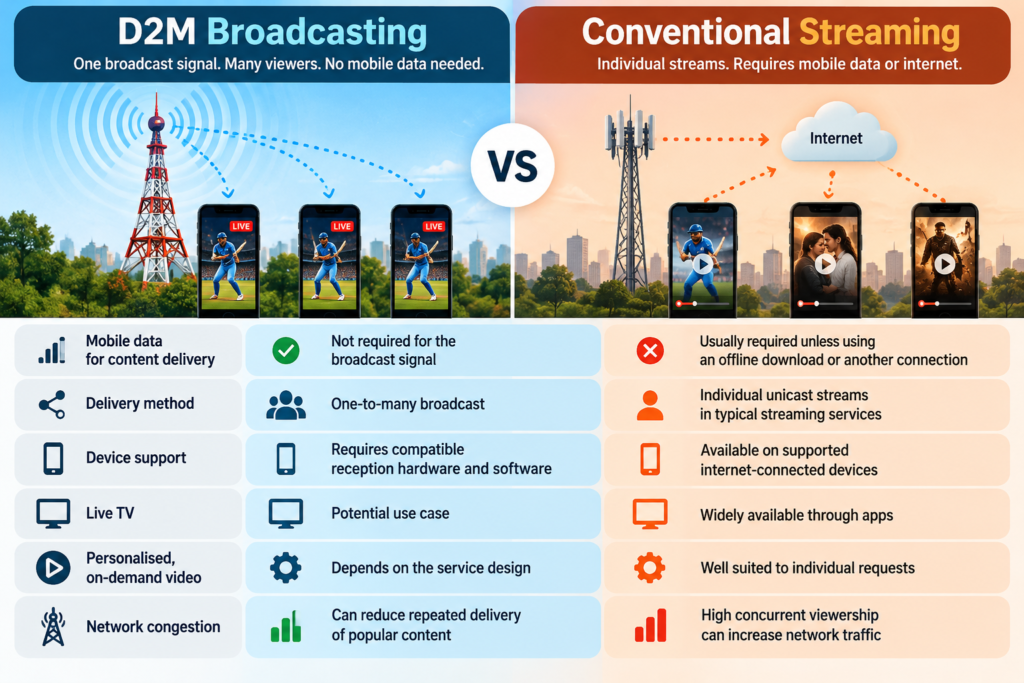
D2M and streaming are not necessarily competitors. They can complement one another.
D2M Frequency Bandwidth Explained: How Many TV Channels Can It Carry?
One of the most important technical details about D2M technology is the radio-frequency spectrum it uses.
In India, D2M trials have used the 470–582 MHz UHF frequency range. This range spans 112 MHz, but that does not mean a single D2M transmission occupies the entire range.
According to Tejas Networks’ published Broadcast Radio Head specifications, its equipment supports broadcast channel bandwidths of 6 MHz, 7 MHz and 8 MHz. The datasheet lists data rates of up to 25 Mbps for a 6 MHz channel and up to 33 Mbps for an 8 MHz channel.
| D2M specification | What it means |
|---|---|
| Frequency range tested in India | 470–582 MHz |
| Total width of that range | 112 MHz |
| Supported channel bandwidths in Tejas’ datasheet | 6, 7 and 8 MHz |
| Listed data rate at 6 MHz | Up to 25 Mbps |
| Listed data rate at 8 MHz | Up to 33 Mbps |
The frequency range above is documented in Prasar Bharati’s D2M test report. The channel bandwidths and data-rate figures come from Tejas Networks’ Broadcast Radio Head datasheet. These are trial and equipment specifications, not confirmation of a nationwide channel lineup.
Can D2M Broadcast Free DD Free Dish Channels?
D2M could potentially deliver free-to-air television content to compatible phones without requiring viewers to use mobile data for the broadcast itself. That makes it relevant to India’s existing free-TV ecosystem.
However, DD Free Dish and D2M are different delivery systems. DD Free Dish is a direct-to-home satellite television platform, whereas D2M uses terrestrial broadcast transmission to reach compatible devices.
D2M could carry selected Doordarshan or other free-to-air programmes if broadcasters make them available through a D2M service and the necessary distribution, spectrum and licensing arrangements are in place. That does not mean D2M automatically receives every DD Free Dish channel.
How Many Channels Could D2M Carry?
The answer depends on the available spectrum, the bandwidth assigned to each transmission, video compression, picture quality, audio requirements and how much capacity is reserved for other data.
For example, a channel carrying compressed standard-definition video generally requires less capacity than one carrying high-quality HD video. A broadcast multiplex can carry multiple services, but the exact number cannot be calculated from the frequency range alone.
D2M’s major advantage is that one broadcast transmission can serve many compatible receivers simultaneously. If thousands of people watch the same live programme, the broadcaster does not need to send each viewer a separate mobile-data video stream.
This could make D2M a useful complement to internet streaming and potentially expand access to free-to-air content—provided the service launches with suitable coverage, devices and a confirmed channel lineup.
If you plan to use your Android phone mainly for media and streaming, keeping it free of unwanted preinstalled apps can also help. Here’s our practical guide on how to remove bloatware apps from Android.
Will Your Existing Smartphone Support D2M?
Not necessarily. Having a 4G or 5G smartphone does not automatically mean it can receive D2M broadcasts.
A device needs compatible reception hardware and software for the particular broadcast implementation. Depending on the design, access might require a D2M-enabled phone, a compatible external receiver or another supported device.
In a September 2024 announcement, Tejas Networks’ subsidiary Saankhya Labs and its partners described plans for consumer trials involving smartphones, USB dongles, set-top boxes or gateways, and a low-cost feature phone. That announcement shows the range of device types being explored. It does not establish that all those products are now commercially available. Before buying a new phone or accessory, check for an explicit compatibility statement from the manufacturer or service provider.
Is D2M TV Free in India? What About the Rollout?
D2M could enable free-to-air broadcasts, but free reception does not automatically mean every channel, programme or service will be free. The eventual experience will depend on the broadcaster, content arrangements, coverage and service model.
India has undertaken technical work on direct-to-mobile broadcasting, including trials and research involving compatible devices and transmission infrastructure. In May 2026, ETTelecom reported that Tejas-developed equipment had cleared reported lab and field trials in Delhi. This is an important technical milestone, but successful trials are not the same as a nationwide commercial launch.
On 6 October 2026, Exchange4Media reported that MeitY would not require phone manufacturers to include D2M hardware; device support is voluntary. The report also said Prasar Bharati was preparing an RFP, with an end-of-October target. Earlier reporting on 30 September had described a similar expected timeline. These were reported plans, not proof that the tender was issued or that public service had launched.
As of 6 November 2026, I could not verify an official public notice confirming a nationwide consumer launch or an issued commercial RFP. The Prasar Bharati circulars page provides an official place to check for new notices. Until a launch, coverage map, supported-device list and channel lineup are published, readers should not assume D2M is available in their area or compatible with their current phone.
Benefits and Limitations of D2M Technology
Potential benefits
- Reduced mobile-data use: Broadcast content can be received without using a separate mobile-data stream for that content.
- Less network congestion: Popular live content can be delivered to many viewers simultaneously.
- Wider information access: Broadcast delivery may help reach people in areas where mobile broadband is weak or expensive.
- Emergency communication: D2M could provide another route for distributing important public information.
- Educational content: Broadcast programmes may help deliver learning resources to underserved communities.
Challenges to solve
- Device compatibility: Existing smartphones may lack the required reception capabilities.
- Coverage and infrastructure: Transmitters must be deployed and maintained to provide useful coverage.
- Content availability: Broadcasters and content providers need to offer programmes people actually want to watch.
- Standards and ecosystem: Devices, networks and services must work together reliably.
- Consumer awareness: Users need clear information about supported phones, coverage, channel availability and any costs.
D2M’s success will depend on solving these practical issues—not only demonstrating that the technology works in trials.
Frequently Asked Questions
1. What does D2M stand for?
D2M stands for Direct-to-Mobile. It refers to delivering broadcast content directly to compatible mobile devices.
2. Can I watch TV on my phone without internet using D2M?
That is one of D2M’s main intended uses. You will need a compatible receiver and access to a D2M broadcast service in your area.
3. Does D2M require a SIM card?
Receiving a broadcast signal does not inherently require an active SIM card or mobile-data connection. Device and service requirements may still vary.
4. Will D2M replace 4G and 5G?
No. D2M is designed to complement broadband networks. Broadcasting is useful for shared content, while mobile broadband remains important for personalised, interactive and on-demand services.
5. Is D2M technology only for television?
No. Potential uses include video, audio, educational material, data distribution and emergency alerts.
Final Verdict: Is D2M Technology Worth Watching?
D2M technology could change how India distributes popular video and public information by combining broadcast efficiency with the convenience of mobile devices. Tejas Networks’ work illustrates how the technology may operate in practice, from broadcast transmitters to intelligent traffic offloading.
However, the real test will be affordable compatible devices, dependable coverage, attractive content and a clearly communicated commercial rollout.