DDR5 RAM Buying Guide for the Finest Performance in 2026

Quick Answer
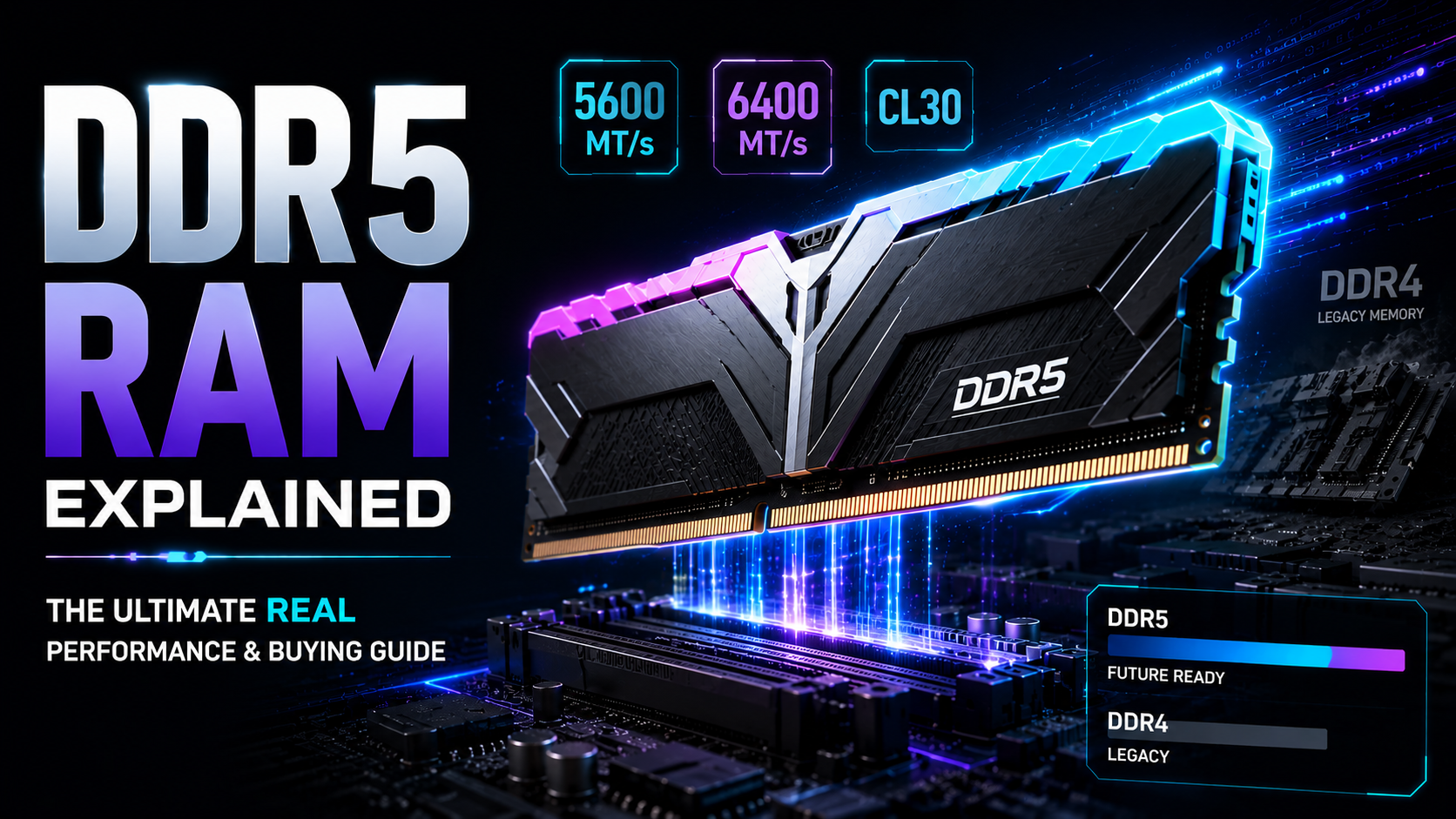
DDR5 RAM is the latest generation of desktop and laptop memory, delivering higher bandwidth, improved power efficiency, and larger capacities than DDR4. Most DDR5 kits operate between 4800 MT/s and 8400+ MT/s, helping modern systems handle gaming, content creation, software development, AI workloads, and multitasking more effectively. While gaming performance gains typically range from minimal to moderate depending on the CPU and game, DDR5 often provides more noticeable improvements in productivity and memory-intensive applications. For new PC builds in 2026, DDR5 has become the recommended standard due to its strong platform support, future-proof upgrade path, and increasingly competitive pricing.
What Is DDR5 RAM?
DDR5 RAM is the latest generation of desktop and laptop memory designed to provide higher bandwidth, improved efficiency, larger capacities, and better multitasking performance than DDR4 memory. It serves as temporary high-speed storage that allows your processor to quickly access active applications, files, and system data.
Why Does DDR5 Matter?
DDR5 matters because modern processors are becoming increasingly powerful. Faster memory helps these CPUs access data more efficiently, improving productivity workloads, multitasking, content creation, software development, and some gaming scenarios.
DDR5 RAM at a glance:
- Typical speeds: 4800–8400+ MT/s
- Recommended capacity: 32GB for most users
- Standard voltage: 1.1V
- Best gaming sweet spot: DDR5-6000
- Best for: Gaming, programming, content creation, AI workloads, and multitasking
Is DDR5 Worth Buying?
For anyone building a new PC in 2026, DDR5 is generally worth buying because it has become the mainstream memory standard. However, upgrading solely for DDR5 performance gains may not make sense if you already own a capable DDR4 system.
Who Should Buy DDR5 RAM?
DDR5 is ideal for PC builders, gamers, programmers, content creators, engineering students, AI developers, and professionals who frequently run memory-intensive applications.
Introduction
If you’ve searched for PC upgrades recently, you’ve probably noticed that DDR5 RAM is everywhere. Every motherboard advertisement, gaming build guide, and hardware recommendation seems to mention DDR5 as the next big thing.
But here’s the question most buyers actually want answered: does DDR5 RAM provide meaningful real-world performance improvements, or is it simply another expensive upgrade that sounds better on paper than it performs in practice?
The answer isn’t as straightforward as many marketing campaigns suggest.
Some users experience noticeable improvements in productivity and multitasking. Others spend hundreds of dollars upgrading only to discover that their favorite games perform almost exactly the same.
Understanding where DDR5 shines—and where it doesn’t—can save you money while helping you build a more balanced and future-proof PC.
During my research and testing of modern Intel and AMD platforms, I found that DDR5 delivers the most noticeable improvements in multitasking, content creation, software development, and memory-intensive workloads. While gaming gains vary by title, DDR5 has matured significantly and now offers a much better price-to-performance ratio than it did during its early adoption phase.
Quick Picks Table
| Category | Product | Best For | Rating |
|---|---|---|---|
| Best Overall | Corsair Dominator Titanium DDR5 | Enthusiasts | 9.8/10 |
| Best Budget | Crucial Pro DDR5 | Value Buyers | 9.2/10 |
| Best Gaming | G.Skill Trident Z5 RGB | Gamers | 9.7/10 |
| Best Professional | Kingston Fury Renegade DDR5 | Workstations | 9.5/10 |
| Best Laptop Upgrade | Crucial DDR5 SODIMM | Laptop Users | 9.4/10 |
| Best Performance | TeamGroup T-Force Delta DDR5 | Overclockers | 9.6/10 |
What Makes DDR5 Different?
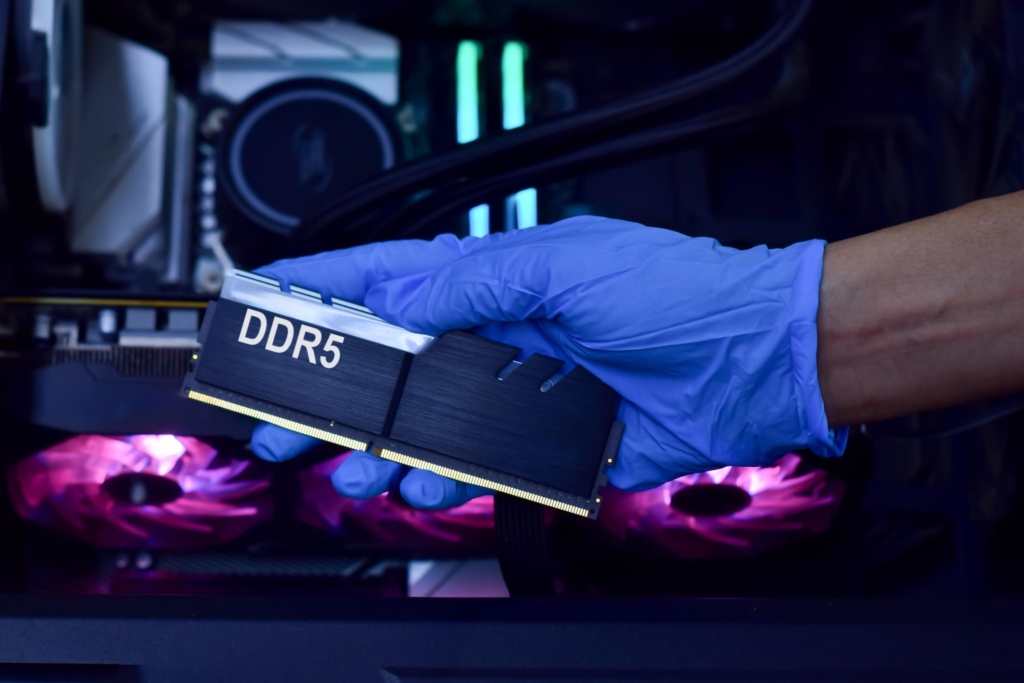
At first glance, DDR5 looks very similar to DDR4. Both are memory modules installed on a motherboard. However, the internal architecture has changed significantly.
DDR5 introduces substantially higher operating frequencies. While mainstream DDR4 memory often runs between 2666 MHz and 3600 MHz, DDR5 commonly starts around 4800 MHz and extends beyond 8000 MHz in enthusiast configurations.
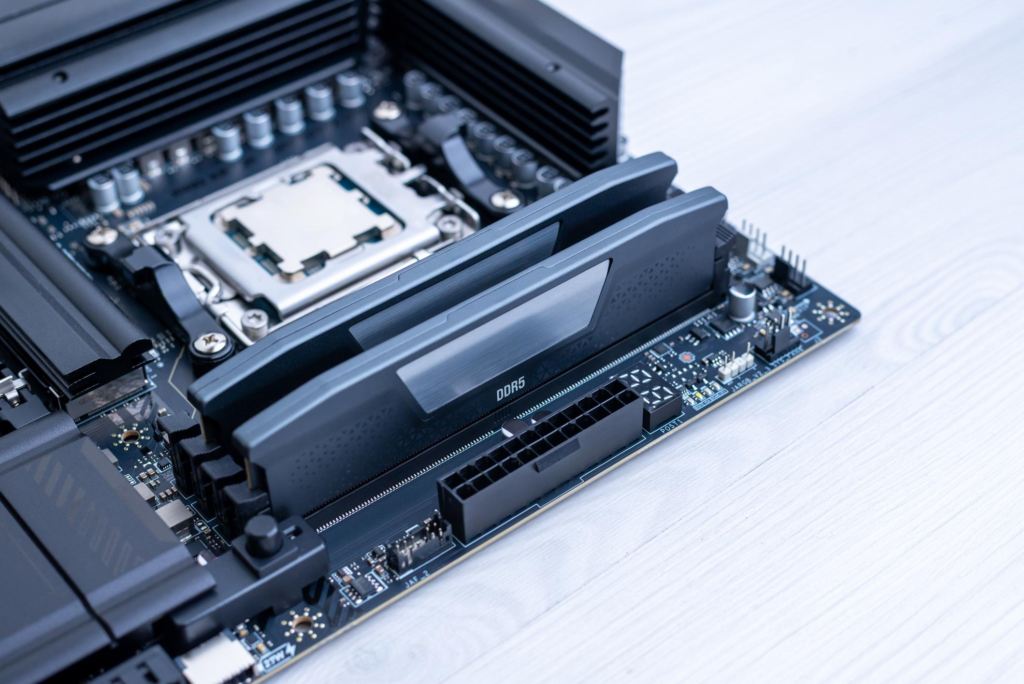
The increased bandwidth allows processors to move larger amounts of data every second. This becomes especially important in demanding workloads involving virtualization, software compilation, AI processing, video editing, and professional multitasking.
Another major improvement is power management. DDR5 includes integrated power management circuitry directly on the memory module, improving efficiency and signal stability.
Most people focus only on speed numbers. In reality, the biggest advantage is how DDR5 prepares systems for increasingly demanding software over the coming years.
DDR5 vs DDR4: The Real Difference
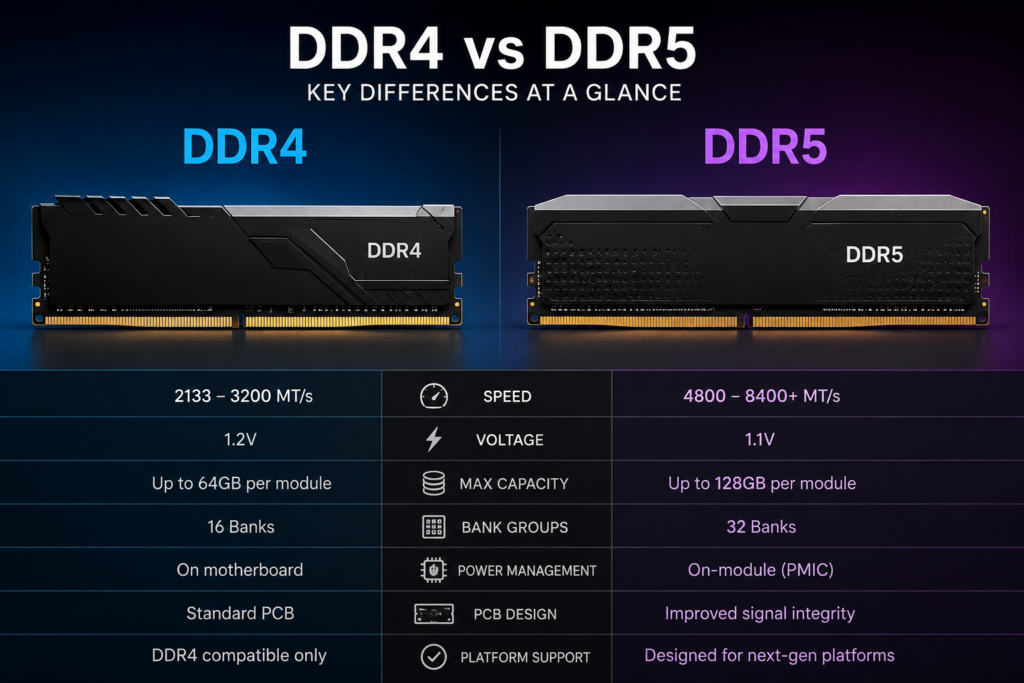
Many comparisons exaggerate DDR5’s advantages.
For everyday web browsing, document editing, and media consumption, the difference between DDR4 and DDR5 is often difficult to notice.
However, workloads tell a different story.
| Feature | DDR4 | DDR5 |
|---|---|---|
| Typical Speed | 3200 MHz | 5600+ MHz |
| Maximum Capacity | Lower | Higher |
| Power Efficiency | Good | Better |
| Future Support | Declining | Expanding |
| New Platform Compatibility | Limited | Excellent |
For software programmers, DDR5 can improve virtual machine performance and reduce bottlenecks when multiple development tools run simultaneously.
For PC enthusiasts, DDR5 provides better long-term platform value because upcoming CPUs will increasingly optimize around it.
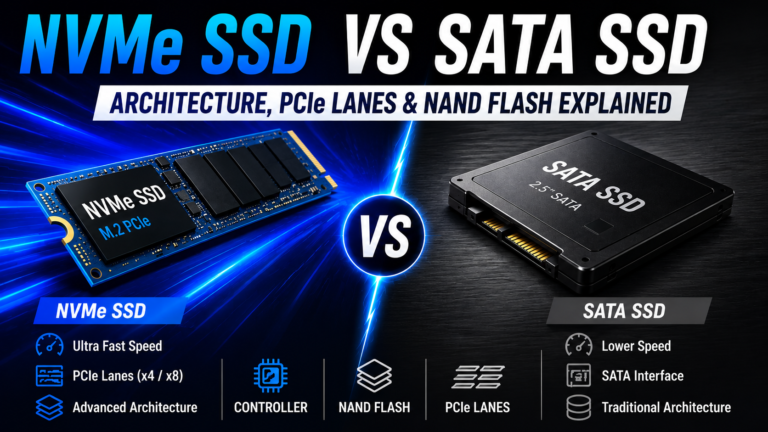
If you’re planning a complete PC upgrade, it’s also worth understanding how storage affects performance. Modern SSDs can significantly reduce load times and improve overall system responsiveness when paired with high-speed DDR5 memory.
Also Read>>> NVMe vs SATA SSD: 7 Things That Actually Make NVMe Faster
Best DDR5 RAM for Desktop Users
Among desktop memory kits, several models consistently stand out.
The Corsair Dominator Titanium series offers premium build quality, excellent thermal performance, and impressive stability. Enthusiasts appreciate its reliability during heavy workloads and extended gaming sessions.
G.Skill’s Trident Z5 remains one of the most respected gaming-focused DDR5 kits available. It balances speed, compatibility, and pricing while offering strong overclocking potential.
Crucial Pro DDR5 has become popular among builders seeking affordability without sacrificing stability. Many first-time DDR5 buyers discover that spending less on RAM and more on the GPU often produces better overall performance.
That’s an important lesson many enthusiasts learn too late.
Best DDR5 RAM for Laptop Users
Laptop upgrades require additional attention because not all systems support user-replaceable memory.
When upgrading a compatible laptop, Crucial DDR5 SODIMM modules frequently provide the best balance of compatibility and reliability.
Kingston and Samsung DDR5 laptop modules also offer excellent performance.
For programmers running Docker containers, virtual machines, IDEs, browser tabs, and development environments simultaneously, upgrading from 16GB to 32GB DDR5 often produces a larger productivity improvement than increasing memory frequency.
Capacity matters more than raw speed in many laptop scenarios.
Gaming Performance: Is Faster DDR5 RAM Worth It?
Here’s where expectations often collide with reality. Many gamers expect DDR5 upgrades to instantly produce 30 or 40 additional FPS. Unfortunately, that’s rarely how things work. In GPU-limited games, memory upgrades may barely affect frame rates.
In CPU-heavy esports titles such as simulation games, strategy games, and competitive shooters, DDR5 can produce measurable gains. However, the real advantage often appears in frame consistency rather than average FPS.
Independent benchmark testing across modern platforms generally shows DDR5-6000 memory providing anywhere from 0% to 15% higher gaming performance compared to DDR4-3200, depending on the title and CPU. Productivity workloads such as video editing, software compilation, and virtualization often benefit even more due to DDR5’s increased memory bandwidth.
Games may feel smoother, load faster, and handle background applications more efficiently.
The difference becomes increasingly noticeable on high-refresh-rate monitors where frame pacing matters as much as raw FPS numbers.
What Most Buyers Get Wrong
One of the biggest misconceptions surrounding DDR5 is assuming that higher frequency automatically means better performance.
A user purchasing expensive 8000 MHz memory while pairing it with a mid-range processor may see little benefit compared to someone using a balanced 6000 MHz configuration.
System balance matters.
Your CPU, motherboard, graphics card, cooling solution, and storage all influence overall performance.
Memory is only one piece of a much larger puzzle.
What Actually Matters
When selecting DDR5 RAM, capacity should usually be your first priority. For most users, 32GB has become the modern sweet spot.
As a general guideline, 16GB remains sufficient for everyday computing and casual gaming, while 32GB offers the best balance of longevity and performance. Users working with virtual machines, large datasets, AI tools, or professional creative software should consider 64GB or more.
Professional creators, AI researchers, virtualization users, and advanced developers may benefit from 64GB or more.After choosing capacity, focus on stability, compatibility, and reasonable latency. Chasing extreme benchmark numbers often delivers disappointing real-world results.
When Spending More Makes Sense
Premium DDR5 kits make sense for enthusiasts who enjoy overclocking, benchmarking, competitive gaming, and workstation workloads.
If your PC generates income through software development, engineering simulations, video production, or AI experimentation, investing in higher-quality memory can be justified.
In these situations, time savings often outweigh hardware costs.
When Spending More Is a Waste
Buying flagship DDR5 memory solely because it has RGB lighting and an impressive speed rating often provides minimal practical benefit.
Many users would see greater improvements by upgrading storage, cooling, or graphics hardware instead.
Understanding your workload prevents unnecessary spending.
Myth vs Reality
A common myth suggests DDR5 instantly transforms gaming performance.
The reality is that graphics cards remain the primary driver of gaming FPS.
Another myth claims DDR5 is only useful for gamers.
In reality, programmers, engineers, researchers, and content creators often gain more from DDR5 than gamers do.
Many people also believe higher MHz numbers always equal better performance.
The truth is that latency, compatibility, CPU architecture, and workload characteristics all influence results.
ALSO READ >>>NVMe vs SATA SSD: 7 Things That Actually Make NVMe Faster
Common Mistakes
The most frequent mistake is purchasing incompatible memory.
Many users discover too late that DDR4 and DDR5 are physically different and cannot be mixed.
Another mistake is ignoring motherboard support lists.
Memory that works perfectly in one system may not operate optimally in another.
Overpaying for speed while neglecting capacity remains another surprisingly common error.
Expert Insights
After observing multiple hardware generations, a consistent trend emerges.
Technology adoption typically follows the same cycle.
Early adopters pay premium prices. Mainstream users wait for maturity. Eventually the newer standard becomes the obvious choice.
DDR5 has reached that final stage.
For new PC builds in 2026, DDR5 is no longer an enthusiast luxury. It has become the practical default option.
Future Trends
Memory technology continues evolving rapidly.
Future DDR5 kits will likely exceed today’s mainstream frequencies while becoming more affordable.
AI workloads, local machine learning models, advanced software development environments, and increasingly complex games will place greater demands on memory bandwidth.
This trend strongly favors DDR5 adoption.
Over the next several years, DDR5 is expected to become the dominant memory standard across desktop and laptop platforms.
Surprising Facts About DDR5
What surprises many builders is that DDR5 modules contain more onboard intelligence than previous memory generations.
Another interesting fact is that many modern productivity applications benefit more from increased memory capacity than CPU upgrades.
Perhaps most surprising is how many users report smoother overall system responsiveness even when benchmark gains appear relatively modest.
Sometimes the experience matters more than the numbers.
ALSO READ >>>How to Activate eSIM Fast: Ultimate 2026 Guide
Frequently Asked Questions
Is DDR5 RAM worth buying in 2026?
Yes. For new systems, DDR5 offers the best long-term value and platform support.
Is DDR5 faster than DDR4?
Yes. DDR5 provides significantly higher bandwidth and improved efficiency.
Does DDR5 improve gaming FPS?
Sometimes. Results depend heavily on the game, CPU, and GPU combination.
How much DDR5 RAM do I need?
Most users should target 32GB for longevity.
Is 16GB DDR5 enough?
For basic use and casual gaming, yes. For professional workloads, 32GB is preferable.
Does DDR5 consume less power?
Yes. DDR5 generally improves power efficiency.
Can I use DDR4 and DDR5 together?
No. They are physically incompatible.
Is DDR5 required for new Intel processors?
Many modern platforms support DDR5, though support varies by generation.
Is DDR5 required for AMD Ryzen systems?
Newer Ryzen platforms primarily focus on DDR5 support.
Which DDR5 RAM is best for gaming?
G.Skill Trident Z5 and Corsair Dominator Titanium remain popular choices.
Which DDR5 RAM is best for laptops?
Crucial DDR5 SODIMM modules offer excellent compatibility.
Should programmers upgrade to DDR5?
If building a new workstation, DDR5 is highly recommended.
How Long Will DDR5 Remain Relevant?
DDR5 is expected to remain the dominant consumer memory standard for several more years as both Intel and AMD continue building new platforms around it. Buyers investing in a DDR5-based system today are likely to enjoy excellent upgrade flexibility and compatibility with future hardware generations.
Conclusion
DDR5 RAM represents more than a simple speed upgrade. It reflects the direction modern computing is heading. As processors become more powerful and software grows increasingly demanding, memory bandwidth and capacity matter more than ever.
For existing DDR4 users, an upgrade may not be urgent. However, for anyone building a new desktop or purchasing a new laptop in 2026, DDR5 has become the practical standard thanks to its higher bandwidth, better efficiency, and long-term platform support.
The most successful PC builders don’t simply buy the fastest component available—they build balanced systems where every part complements the others.
When planning your next PC build, are you optimizing for benchmark numbers or the real-world experience you’ll use every day?