SRAM vs DRAM Explained: 5 Key Differences, Working, Diagram (Easy Guide)

When you start learning digital electronics or computer architecture, one of the first confusing topics you come across is SRAM vs DRAM. At first glance, both seem to do the same job—they store data. So a common question naturally comes up: why do we need two different types of memory?
Table of Contents
The answer lies in how modern systems balance speed, cost, and efficiency. Not all memory is designed for the same purpose. Some parts of a system need extremely fast access, while others need to store large amounts of data at a lower cost. This is exactly where SRAM and DRAM come into play.
SRAM is designed for speed and stability, which is why it is used in cache memory close to the processor. DRAM, on the other hand, focuses on capacity and cost efficiency, making it suitable for main memory in devices like laptops and smartphones. Understanding how these two work together gives you a much clearer picture of how real-world computing systems are designed.
In this guide, we will break down the difference between SRAM and DRAM in a simple and practical way. Instead of just definitions, you will understand how they actually work, where they are used, and why both are essential in modern computing.
What is SRAM (Static Random Access Memory)?
SRAM, or Static Random Access Memory, is a type of volatile memory that stores data using a stable electronic circuit. The word “static” refers to the fact that the stored data remains unchanged as long as power is supplied. Unlike some other memory types, SRAM does not require any periodic refreshing to maintain its data.
At its core, SRAM uses a structure similar to a flip-flop, which is capable of holding a binary value indefinitely while power is present. This makes SRAM extremely fast because the data is always ready to be accessed without any delay caused by refresh operations.
When you think of SRAM in simple terms, imagine a switch that stays in its position once it is set. It does not need to be checked or corrected repeatedly. This stability is the key reason behind its high performance.
SRAM Cell Structure and Diagram


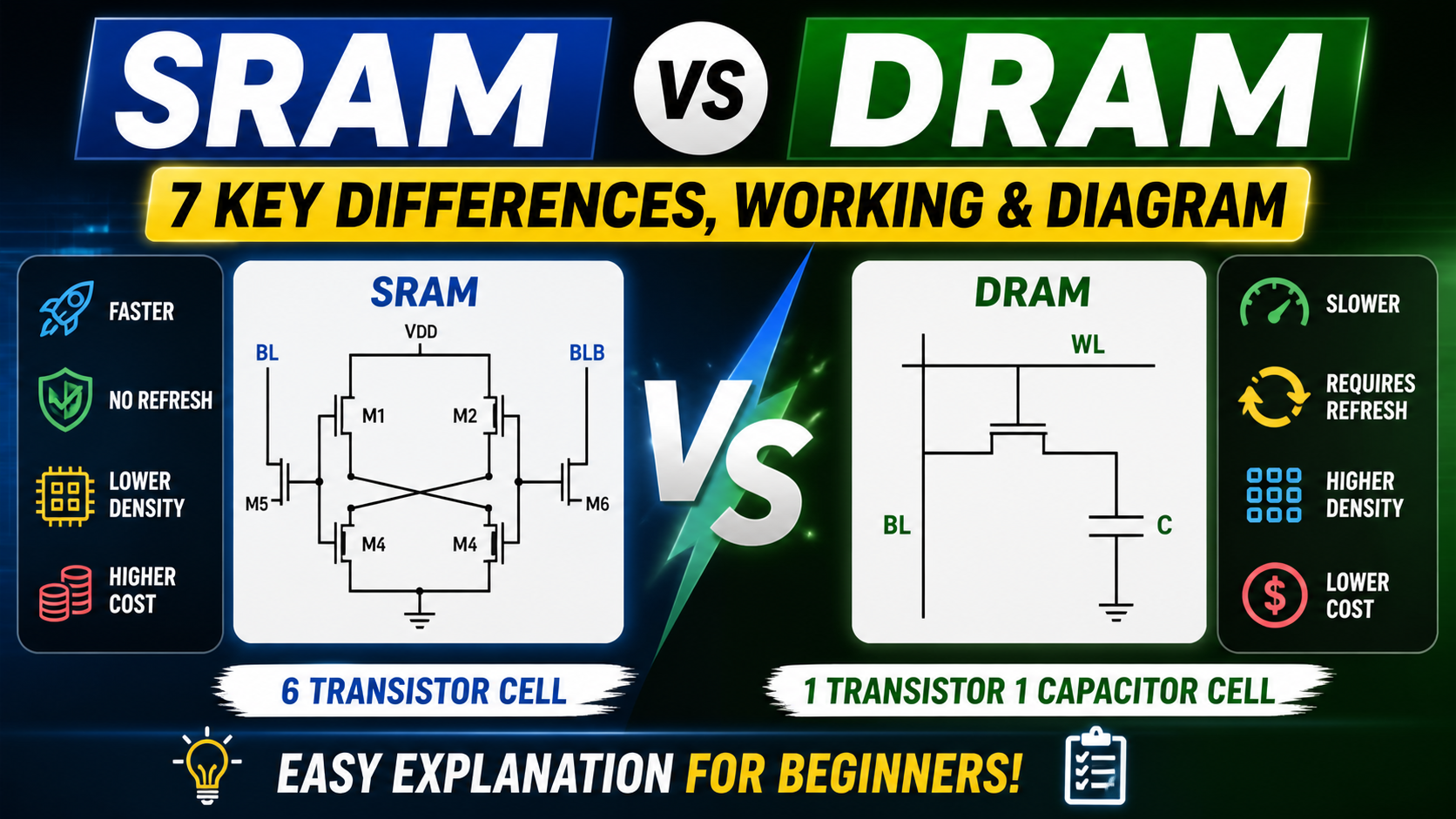
An SRAM cell is typically made up of six transistors, which is why it is commonly called a 6T SRAM cell. These transistors form two cross-coupled inverters that create a feedback loop. This loop ensures that once a value is stored, it remains stable without any external intervention.
In addition to the storage elements, there are access transistors that connect the cell to bit lines. These bit lines are used during read and write operations, while the word line controls whether the cell is active or not.
Even though this structure may appear complex, it is precisely this complexity that allows SRAM to operate at very high speeds.
How SRAM Works
The working principle of SRAM is based on maintaining a stable state using feedback. When a value is written into the memory cell, it is stored in the form of voltage levels within the inverter loop. This loop continuously reinforces the stored value, ensuring that it does not change unintentionally.
During a read operation, the stored value is directly accessed through the bit lines. Since the data is already stable and does not need to be refreshed, the read operation is extremely fast. Similarly, during a write operation, the existing value is overwritten by forcing a new value into the cell.
Because there is no need for refresh cycles, SRAM provides low latency and high-speed performance, making it ideal for applications where quick access to data is critical.
What is DRAM (Dynamic Random Access Memory)?
DRAM, or Dynamic Random Access Memory, is another type of volatile memory, but it works in a completely different way compared to SRAM. Instead of using a stable circuit, DRAM stores data as an electrical charge in a capacitor.
The term “dynamic” comes from the fact that this stored charge does not remain constant. Over time, the charge leaks away, which means the data can be lost if it is not refreshed periodically.
A simple way to understand DRAM is to think of it as a container that slowly leaks water. To keep it full, you need to refill it regularly. In DRAM, this refilling process is called refreshing.
DRAM Cell Structure and Diagram


A DRAM cell is much simpler than an SRAM cell, which is one of the key points in understanding SRAM vs DRAM. It consists of only one transistor and one capacitor, which is why it is often referred to as a 1T1C cell.
The capacitor stores the data in the form of charge, while the transistor acts as a switch that controls access to the capacitor. This simple design allows DRAM to achieve much higher density compared to SRAM, which is a major difference in the SRAM vs DRAM comparison, as more memory can be packed into a smaller area.
How DRAM Works
The operation of DRAM revolves around storing and maintaining charge, which highlights another important concept in SRAM vs DRAM explained topics. When a binary value is written into a DRAM cell, the capacitor is either charged or discharged. A charged capacitor represents a binary 1, while a discharged capacitor represents a binary 0.
However, the stored charge does not remain forever. Due to leakage, the charge gradually decreases over time. To prevent data loss, the system periodically reads and rewrites the data, restoring the charge in the capacitor. This process is known as refreshing.
While this approach allows DRAM to be more compact and cost-effective, it also introduces delays and additional power consumption. This is why, in the overall SRAM vs DRAM comparison, DRAM is considered slower than SRAM despite its higher storage capacity.
SRAM vs DRAM: Key Differences Explained Clearly


The difference between SRAM and DRAM mainly comes from how each type stores data, which is a core concept in understanding SRAM vs DRAM. SRAM uses a stable circuit that does not need refreshing, while DRAM relies on a capacitor that must be refreshed continuously to retain data.
This fundamental difference directly affects performance in the SRAM vs DRAM comparison. SRAM is faster because it can provide data instantly without waiting for refresh cycles. DRAM, on the other hand, is slower due to the extra time required for refreshing and sensing the stored charge.
Another key point in SRAM vs DRAM explained topics is cost and density. SRAM requires more transistors per cell, which makes it larger and more expensive. In contrast, DRAM uses fewer components, allowing it to achieve higher density and store more data at a lower cost.
Performance Comparison and Behavior

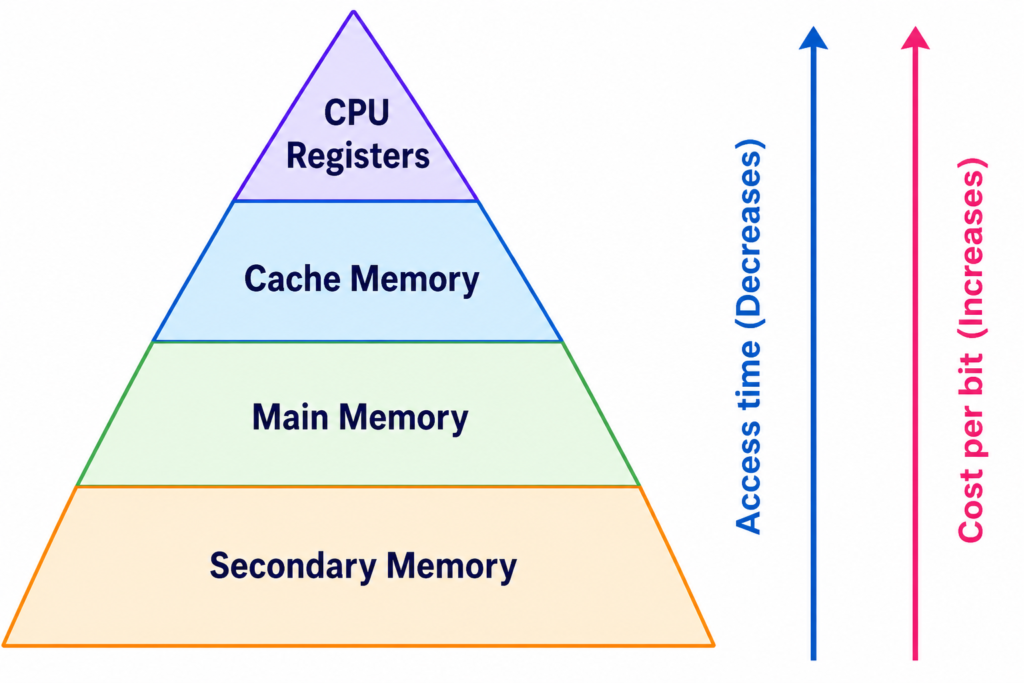

When comparing performance in SRAM vs DRAM, SRAM clearly stands out in terms of speed. It can operate at very high frequencies and provide low-latency access to data, which makes it ideal for cache memory where quick access is critical.
DRAM, on the other hand, behaves differently in the SRAM vs DRAM comparison. While it is slower, it offers much higher storage capacity and is designed to handle large amounts of data efficiently. This is why DRAM is commonly used as the main memory in computers and mobile devices.
This difference in speed and capacity between SRAM vs DRAM leads to an important design concept known as memory hierarchy, where both types of memory are used together to balance performance and cost.
Also Read
- Innovations in Semiconductor Technology Leading from CPUs to AI Chips
- What is a VNA & How to use a network analyzer?
Why Modern Systems Use Both SRAM and DRAM
In real-world systems, relying on only one type of memory is not practical, which is an important idea when understanding SRAM vs DRAM. If SRAM were used for all memory, the system would become extremely expensive and physically large. On the other hand, using only DRAM would lead to slower performance, as seen in many SRAM vs DRAM comparisons.
To overcome this limitation, modern systems use a layered approach. In this SRAM vs DRAM architecture, SRAM is used in cache memory to store frequently accessed data, while DRAM is used as the main memory to handle larger amounts of data.
This combination allows systems to balance speed and cost effectively, which is why the SRAM vs DRAM concept is essential in designing efficient and high-performance computing systems.
Real-World Example for Better Understanding SRAM VS DRAM
Consider what happens when you open an application on your computer. The data that is accessed frequently is moved into the cache, which is made of SRAM. This allows the processor to retrieve the data quickly.
At the same time, the rest of the application data is stored in DRAM, which provides the necessary storage capacity. This division ensures that the system runs smoothly without unnecessary delays.
SRAM vs DRAM in VLSI Design
In VLSI design, SRAM and DRAM play different roles. SRAM is typically used for on-chip memory, such as cache and buffers, where speed is critical. DRAM is used as off-chip memory, where large storage is required.
Understanding how these memory types are designed and integrated is important for engineers working in semiconductor and ASIC design roles.
What is the Basic difference between SRAM and DRAM?
SRAM is a fast memory that stores data using flip-flop circuits and does not require refreshing, while DRAM stores data using a capacitor and requires periodic refreshing, making it slower but more cost-effective.
FAQs
Why is SRAM faster than DRAM?
SRAM is faster because it stores data in a stable circuit and does not require refresh operations.
Why does DRAM need refresh?
DRAM uses capacitors that lose charge over time, so refreshing is needed to maintain data.
Where is SRAM used?
SRAM is used in cache memory and high-speed components of processors.
Where is DRAM used?
DRAM is used as the main memory in computers, laptops, and smartphones.
Which is cheaper, SRAM vs DRAM?
DRAM is cheaper due to its simpler structure and higher density.
Conclusion
SRAM and DRAM are both important types of memory, but they serve different roles in modern computing systems. SRAM is all about speed and stability, which is why it’s used in cache memory, while DRAM focuses on providing larger storage at a lower cost, making it ideal for main memory.
Once you clearly understand the difference between SRAM and DRAM, many concepts in digital electronics and VLSI start to make much more sense. It not only helps in exams and interviews but also gives you a clearer picture of how real-world systems actually work behind the scenes.
When you look at modern devices with this understanding, you can truly appreciate the design decisions engineers make to balance speed, cost, and efficiency.
If you found this useful or still have any doubts, drop a comment below. I’d love to hear your thoughts. And if you have any suggestions or topics in mind, feel free to share—I’ll try to cover them next.